News

Microsoft names around 4,000 MVPs worldwide: Two of them work at Informotion

Every year, Microsoft decides who keeps the Most Valuable Professional title and who loses it. Around 4,000 people worldwide make the cut. A little over 100 of them are in Australia, and two of those work at Informotion: Andrew Ly and Andrew O’Young. 

The MVP award is not a certification. Nobody sits an exam, and there is no way to buy in. A candidate must be nominated by a Microsoft employee or an existing MVP, then stand up to a review of a full year of evidence: conference talks, published guidance, open-source contributions, and the unglamorous hours spent answering other practitioners’ questions. The title expires after twelve months. Keep contributing, developing and delivering … or hand it back. 

That makes the MVP award one of the few claims of expertise in this market a customer can check for themselves. It is Microsoft’s own verdict, delivered annually, on who is genuinely shaping and expanding new and innovative ways how its technology gets used.

Meet Informotion’s Microsoft MVPs

Andrew Ly 

Nine-time Microsoft MVP, Business Applications. Six-time FastTrack Recognised Solution Architect. 

Andrew has held his MVP award nine years running, in the Business Applications category, which fewer than 500 people worldwide can claim. He specialises in Microsoft Power Platform, Power Apps and Dynamics 365, and brings more than 25 years of Microsoft delivery to helping organisations rebuild slow, manual processes as modern business applications. 

His FastTrack Recognised Solution Architect title does a different job to the MVP. FTRSA comes from Microsoft’s engineering organisation, and it is earned on delivery: published reference architectures and customer implementations that Microsoft’s own architects have pulled apart and approved. Around 170 architects worldwide hold it. Microsoft calls it the highest recognition it gives a solution architect, and Andrew has earned it six times. 


I’ve been fortunate to learn from a lot of talented people throughout my career, so contributing back to the Microsoft community feels like a natural part of the job. The real value of the award is the access that comes with it. I spend time with the product teams and see where AI/Copilot, Power Platform and Dynamics 365 are heading, and that goes straight into the advice our customers get.” 

-Andrew Ly, Al Business Process Capability Lead – Microsoft Cloud and Al, Informotion


Andrew O’Young

Three-time Microsoft MVP, Security and M365

Andrew holds MVP awards in two categories at once, Security and M365, with a specialisation in Microsoft Intune. Across more than a decade of consulting he has helped organisations strengthen their security posture and modernise how their people work in Microsoft 365. 

He is also one of the busier community builders in the Australian Microsoft scene, contributing through user groups, events, podcasts and technical sessions. In 2026 Microsoft went a step further and selected him as a Regional Leader in the Microsoft Global Community Initiative, joining a hand-picked global cohort trusted to grow technical communities in their regions. 

“The Microsoft community connected me with the people and opportunities that shaped my career, so the MVP award and the MGCI role are a chance to give some of that back. It works in both directions, too. Whatever problem a customer’s project runs into, if I don’t have the solution or answer, someone in that network has usually seen it before, and I know who to ask.”

-Andrew O’Young,  AI Workforce & Security Capability Lead – Microsoft Cloud & AI, Informotion


What this means when you work with us

The value of an MVP on your project comes down to access. MVPs work under a non-disclosure agreement with Microsoft, testing preview builds months before general availability and sitting in briefings at the annual MVP Summit in Redmond that never leave the room. They also hold direct lines to the engineers who build the products. So when your project hits a product limitation or an undocumented behaviour, the question goes to the person who wrote the feature rather than into a support queue. Advice given today already accounts for what Microsoft will ship in six months, which keeps you from building something the platform is about to make redundant.

None of it is self-assessed, either. MVP status is re-judged by Microsoft every year against fresh evidence, and FTRSA is granted for real customer implementations that Microsoft’s architecture team has examined line by line. Together they amount to an outside audit of what our people know and what they have shipped, done before you have read a single page of a proposal.

The questions we hear most

Most conversations with us start in one of a few places: where to begin with Microsoft Purview, which AI use cases deserve to go first, or how to get more from an existing OpenText Content Manager data. If any of those sound familiar, talk to the team. The advice comes from people Microsoft re-checks every year. 

Solving the Information Governance Gap in the Era of Information Overload

How Artificial Intelligence Is Transforming Information Governance

Organisations today generate more information than ever before. Emails, documents, collaboration tools, and shared workspaces create enormous volumes of digital content every day. While digital transformation has made work faster and more collaborative, it has also made information governance significantly more difficult.

For years, organisations have struggled to keep their records organised, compliant, and easy to manage. Traditional governance approaches relied heavily on employees manually registering and classifying records. As information volumes increased, this approach became harder to sustain.

This article explores how information governance evolved during the digitisation era, why many organisations experienced governance fatigue, and how systems like SharePoint and artificial intelligence (AI) are now helping close the governance gap.

The Digitisation Era: Moving from Paper to Electronic Records

Between 2005 and 2015, many organisations transitioned from predominantly paper-based processes to electronic record keeping. Governments, regulators, healthcare providers, and private organisations invested heavily in electronic document and records management systems (EDRMS) and compliance frameworks.

During this time, record keeping and sharing improved significantly. EDRMS’ allowed organizations to store documents more efficiently, apply classifications, and maintain long-term archives. Sharing documents became much easier too, with request processes being digitised and documents delivered directly to a person’s digital work-tray.

By the late 2010’s, however, something unexpected began to happen. The number of records being registered in mandated recordkeeping systems stopped increasing.

This did not mean organisations were producing fewer documents. In fact, digital content was growing rapidly, particularly through email and collaboration tools. The real issue was that employees were reaching the limits of how much governance work they could realistically manage.

The Rise and Fall of Records Capture

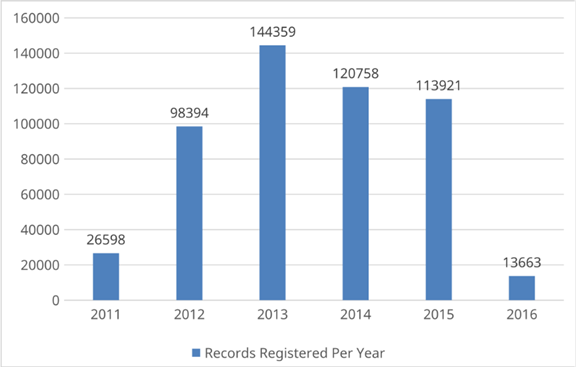
Figure 1 (left) shows record registration trends within a regulatory organization in Victoria. The chart demonstrates steady growth in registered records until 2013. After that point, record registrations plateaued.

This plateau was not caused by a decrease in activity. Instead, it reflected governance fatigue. Employees were required to complete record registration tasks alongside their regular responsibilities, including entering metadata and deciding how documents should be classified and stored.

As document volumes increased, maintaining these processes became increasingly difficult.

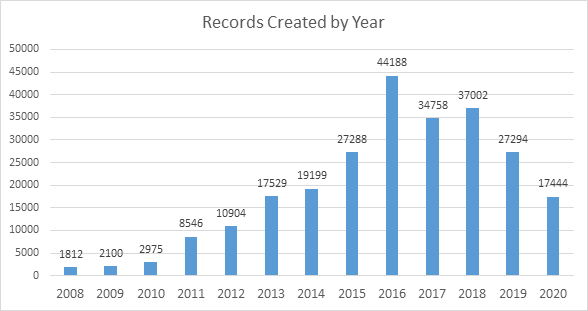
Figure 2 (right) shows a similar trend within a health organisation in New South Wales. Record registration increased steadily until reaching a peak in 2016.

After this point, the number of registered records declined slightly or remained flat. Again, this did not indicate reduced organisational activity. Instead, it highlighted the growing challenge of maintaining electronic record keeping as information volumes expanded.

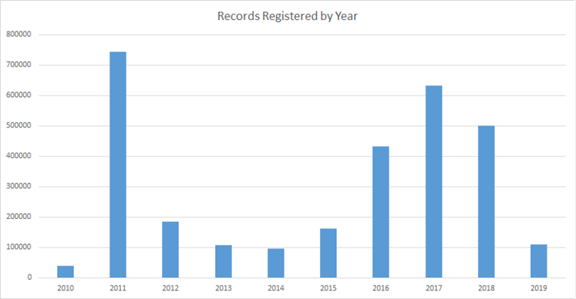
Figure 3 (left) illustrates record registration within a water utility organisation. The chart shows a peak in 2017, followed by a plateau.

The large spike in 2011 represents a one-off bulk import of records rather than normal operational activity. Aside from this anomaly, the pattern closely mirrors other organisations: steady growth followed by stagnation as governance processes became harder to sustain.

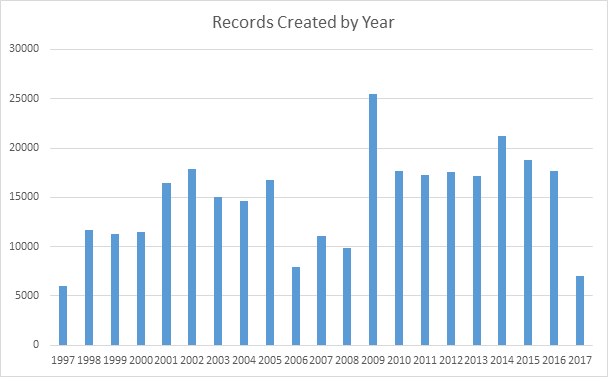
Figure 4 (right) provides a final example from another health district in New South Wales. The same pattern is visible once again.

Record registrations initially increase as digital systems are adopted but eventually stabilise as employees reach the limits of manual record management processes.

Across multiple organisations and industries, these figures reveal a consistent pattern: electronic record keeping improved rapidly during digitisation but eventually plateaued due to governance fatigue.

Governance Fatigue and the Rise of Collaborative Systems

At the same time governance fatigue was increasing, collaboration platforms were becoming more widely used across organisations. One platform that became especially common was Microsoft SharePoint.

Originally introduced in the early 2000’s, SharePoint evolved into a major enterprise collaboration platform. By the mid-2010’s, it was widely used for document sharing, team collaboration, and project workspaces.

SharePoint made it easy for teams to create sites, share documents, and collaborate on projects. However, in many organisations these environments were created quickly and often without strong governance controls. As a result, information began flowing into systems that required less effort from employees.

Like water finding the path of least resistance, documents were increasingly stored in collaborative workspaces rather than formal record management systems.

Over time, many organisations developed large collections of documents stored across multiple platforms, including network drives, email systems, and SharePoint environments. While these systems supported collaboration effectively, they often lacked consistent classification and governance.

The Limits of Human-Centric Information Governance

For years, organisations attempted to solve governance challenges by making record registration easier.

Common approaches included:

  • reducing the amount of required metadata
  • automating parts of the registration process
  • simplifying workflows for capturing records

These improvements helped reduce friction, but they could not fully solve the problem. Employees were still responsible for interpreting documents and deciding how they should be classified and managed.

Some organisations attempted to control collaboration platforms by enforcing mandatory metadata or restricting site creation. Others accepted the growth of unstructured content and reduced their governance requirements.

Despite these different approaches, the same fundamental challenge remained:

How can organisations consistently determine what a document is, how long it should be retained, and how it should be governed without relying on manual decisions from employees?

For many years, there was no scalable solution.

Artificial Intelligence and Automated Document Understanding

Artificial intelligence is often associated with content generation tools. However, one of its most practical applications lies in analysing and understanding documents.

Modern AI systems can examine the contents of documents and determine their meaning and context. This capability allows organisations to automatically identify document types and apply governance rules.

In practical terms, AI can help organisations answer an important question: “What is this document?”

By analysing the text, structure, and context of a document, AI systems can determine:

  • the type of record it represents
  • how it should be classified
  • how long it should be retained
  • which governance rules apply

Historically, these decisions required trained records managers or knowledgeable employees to review documents manually. AI now makes it possible to perform this analysis automatically at scale.

This allows organisations to:

  • discover records across different systems
  • understand the business value of documents
  • apply classification and retention rules automatically

By removing the need for manual interpretation, AI reduces the administrative burden placed on employees while enabling records and compliance experts to focus on high value strategic initiatives.

Closing the Information Governance Gap

Structured governance did not fail because it lacked importance. Instead, it struggled because it relied heavily on manual human effort while the volume of digital information continued to grow. The rapid expansion of collaborative platforms and unstructured repositories made this challenge even greater.

Today, artificial intelligence provides a new approach to information governance. By automatically analysing and classifying documents, organisations can restore governance controls without relying entirely on employees to manage records manually. AI governance processes can maintain human-in-the-loop controls to ensure classification of documents and policy application is correct.

As digital information continues to grow, intelligent automation will play an increasingly important role in maintaining compliance, improving information management, and restoring trust in organisational records. Appropriate and considered application of AI can be used to augment the knowledge and skills of records and information management professionals, driving better business outcomes for all stakeholders.

About Informotion

For over 25 years, Informotion’s team has specialised in compliance and records management, guiding regulated organisations globally through complexity with clarity, confidence, and proven expertise. Today, as data moves to Cloud, AI, and automation, Informotion bridges heritage governance with future-ready innovation, to help organisations transform complex data into actionable insights, wherever they operate.

Would you like to know more? Start a conversation and Contact Us

Speak with our team about tailored data solutions.

Subscribe

Sign up to our Newsletter.

Contact

Australia
T - 1300 474 288

L12, 50 Carrington St,
Sydney NSW 2000.

United Kingdom
T - +44 2080 890 523

United Kingdom Office
Waterside
1650 Arlington Business Park
Theale Reading
Berkshire, RG7 4SA